The words ‘rare teas’ have become common place in the greater industrialized tea world. Anything but CTC or machine made teas have been called ‘rare teas’ by marketers, justifying such usage to mean ‘not infinitely available nor blended into blandness’. But in the artisan tea world, rare teas are single lot, often made in small batches of less than 100 lbs.. In addition, the rarity must be attributed to conditions that limit possible additional production, either by nature or nurture. Some are dependent on a confluence of conditions, such as the Leaf Hopper bitten Taiwan Beauty of Taiwan. Some are grown on such high elevations, like the Dayuling at 2,500 meters or higher, that by nature of the limited growing areas, the teas are few in yield. Still others, like many Phoenix teas, are harvested from single, antiquated tea trees that are hundreds of years old. In the Yunnan region…
Artisan Tea Producer: Mr. Zhang of Wuyi Mountain, China
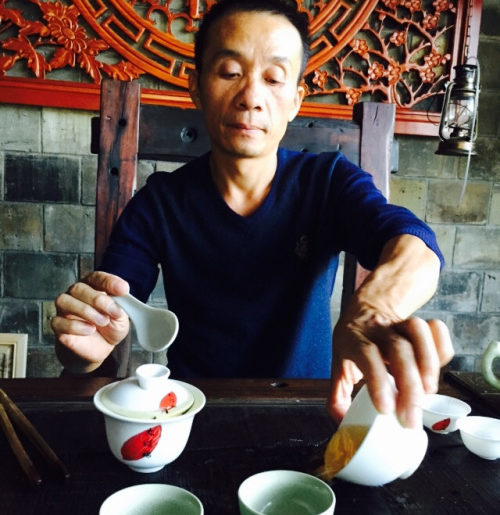
So many of the artisans that we buy teas from are unique and deserve the utmost attention and respect. It’s difficult to choose just one to highlight. Mr. Zhang, of Wuyi Mountain, China, however, would definitely be the first. Wuyi ‘Rock’ teas were often State gifts from the Central Chinese government to other dignitaries, such as the President of the United States. As a result, the requirements of being an acknowledged artisan in a fabled tea producing region is quite high. Wuyi Mountain is a legendary scenic area of some of the most pristine waters and cliffs, with a unique terroir that commands some extreme requisites for growth. Mr. Zhang has tackled the job of mastering what is traditional farming and processing techniques. He has also created personalized equipment to make exceptional versions of Wuyi teas. Wuyi teas are arbor type Camellia Shuixian varietals that grow on just 10cm of soil, and…
Royal Courtesan Oolong: One of the most unusual teas
One of the most unusual teas on the planet- those bitten by a tiny bug- is the Royal Courtesan oolong. A perfect storm of conditions must occur for this tea to be made. Green Leaf Hoppers are tiny cicada native to Taiwan, and they feast on the small undeveloped tea leaf buds, drawing the astringent juices as their meal. In return, the tea leaf defends itself by sending polyphenols to the bite wounds, and a large amount of fragrance compounds also rush to the surface. We do not know exactly why that happens, but we hare happy to be the beneficiaries- the Leaf Hopper bitten teas have a surreal perfume that incites names such as Taiwan Beauty, and Royal Courtesan. However, unlike Taiwan Beauty, which grows on low elevations in order for the Leaf Hoppers to reach them- Royal Courtesan is made from Tung Ting Oolong, growing at 800 meters…
Know Your Tea: An Interview with Ashok Kumar, Owner of Goomtee Estate
In China, the most exciting new green teas of the season are invariably Pre-Ming or Pre-Rain, with Dragonwell leading the way to being the most sought after in that category. In Japan, it’s called Shincha,or ‘New Tea’. Elsewhere in the world, First Flush Darjeeling is the biggest deal for tea aficionados! We love this early, almost green, version of Darjeeling for its very unique spicy fragrance, and honeywater taste and texture. Here, we interviewed Mr. Ashok Kumar, owner of Goomtee Estate in Darjeeling, to hear from him directly what he thinks about this year’s crop, and other issues: 1. Where is Goomtee situated relative to other Darjeeling farms, and position advantages, if any? Any particular terroir differences? Darjeeling farms are generally located between 1500′-6500′ above msl. Goomtee ranges from 2500′-6500′, avoiding low grown teas. Further, we are located in between Jungpana to the south and Castleton in the north which are among the best marks in Darjeeling. We mostly have the varieties planted…
Biodynamic Farming and Organic Certifications
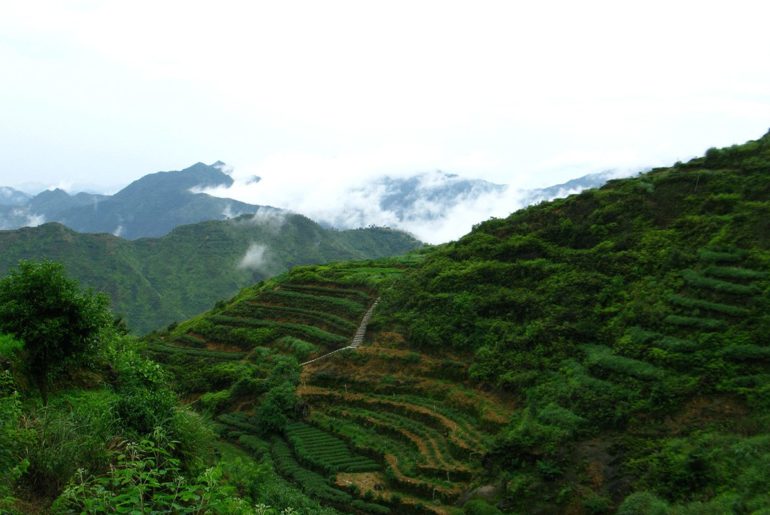
One of our favorite producers, Mr. Lin, has recently acquired a new farming area in Anxi, and plans to devote 30 years to creating the best biodynamic farm in his region. His new property, a large mountain by his existing farm, boasts the perfect confluence of factors for growing great tea. It is an enormous mountain after all- at 948 meters elevation, perfect conditions include the best water in the province and constant winds. Mr. Lin has long been our go-to producer for USDA, EU, and JAS certified Organic High Mountain Oolongs, and is no stranger to organic farming methods. We’re often asked why more of our teas do not carry organic designations, as the prevailing opinion in the Western world is that “organic” is the end all, be all indicator of quality. Unfortunately, the cost of acquiring USDA certification is quite high, and would make many of the teas we carry prohibitively expensive, considering many…
Tea as Chinese Herbal Medicine
Chinese herbal medicine, of which tea is a part of, is far from easy to drink. Usually dark, potent, and downright nastily bitter and pungent, I would rather drink gallons of tea as preventive than one of those bitter brews. But this extensive pharmacology of 3000 years works. Here, a glimpse of herbal medicines in Hong Kong.