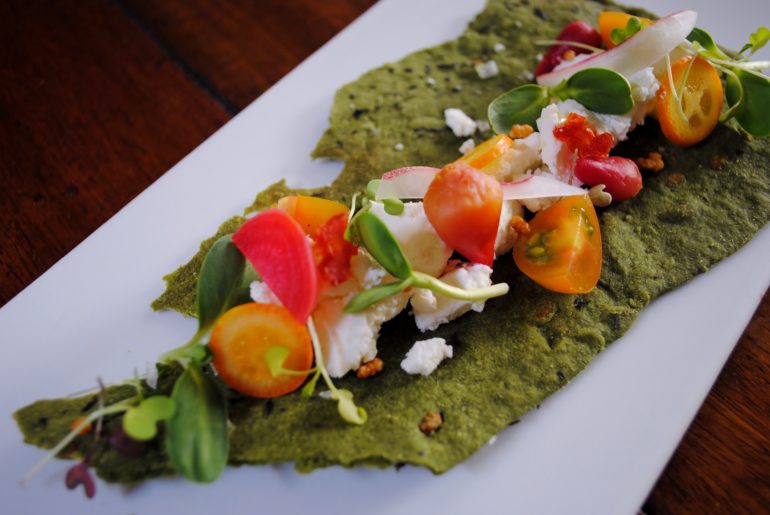
Recipe courtesy Melanie Franks: INGREDIENTS: 1½ cups all-purpose flour 2 teaspoons matcha powder 1 teaspoon salt 1 teaspoon sugar 2 tablespoons olive oil ½ cup cold water 1 teaspoon sea salt 2 teaspoon genmaicha 1 egg white, whisked 1.Preheat the oven to 450 degrees. Pulse the flour, matcha tea, salt, sugar, and olive oil in the food processor until evenly distributed. 2.Add the water and pulse just until the dough starts to stick together (about 10 seconds). Remove the dough, press together gently with your hands to form a single ball, and cut into four pieces. Let the dough rest for about 30 minutes in the refrigerator. 3.Roll out each individual piece of dough as thin as you possibly can. I like to use a pasta machine for this process. If the dough starts to shrink up, let it rest a little longer. You want the dough to get very, very…
LuShan Creme Brûlée
From F. Lit Yu’s soon to be released “Haute Tea Cuisine, New Techniques for Infusing French Food with Tea” Photo by Ching-Wei Jiang INGREDIENTS: 1 ounce LuShan Clouds & Mist Green Tea 5 1/2 cups heavy cream 6 egg yolks 6 tbsp sugar Additional sugar for caramelizing 1. Bring the heavy cream to a boil and add the LuShan Clouds and Mist. Turn off the heat, cover, and extract for one hour. Strain and discard the used tea leaves. Preheat oven to 375˚F. 2. In a mixing bowl, combine the tea-infused heavy cream with the yolks and the sugar and beat well with a hand-mixer or a whisk. Pour into oven-proof ramekings and set on a deep baking pan. Pour half an inch of water into the pan holding the ramekins. 3. Loosely cover the pan with foil and bake for 25 minutes. The center of the custard should…
Spinach in Jin Shuan Oolong Clam Sauce
From F. Lit Yu’s soon to be released “Haute Tea Cuisine, New Techniques for Infusing French Food with Tea” Photo by Ching-Wei Jiang INGREDIENTS: 1/2 ounce Jin Shuan Oolong Tea 1 pound spinach 16 ounces clam juice 2 shallots 1 tomato 1 cup heavy cream butter 1 cup white wine 1. Extract the Jin Shuan in the heavy cream, and allow to sit covered, with the heat off for one hour. Strain and discard the used tea leaves. 2. Chop the shallots and tomato. In a saucepan, melt the butter and brown the shallots for about a minute. Deglaze with white wine. Pour in the clam juice and stir in the tomatoes. Bring back to a boil before reducing the heat to a simmer. Reduce the liquid volume to about 25 percent. 3. Pour the tea-infused cream directly into the pan and continue to reduce until half of the liquid…
Archaeologists discover world’s oldest tea buried with ancient Chinese emperor
The discovery shows how modern science can reveal important previously unknown details about ancient Chinese culture. The identification of the tea found in the emperor’s tomb complex gives us a rare glimpse into very ancient traditions which shed light on the origins of one of the world’s favourite beverages,”
Know Your Tea: Guanyin Red, a Hidden Gem in Our Collection
When Hongcha, or Red teas, were first developed, it was a laborious process that required extreme expertise, oxidizing intact whole tea leaves by hand, for what is sometimes 5-6 hours, and just by feel. This requires the tea master to be able to drive all the aromatic oils by flushing the veins of the tea leaves, while accounting for ambient humidity, the condition of the leaves after picking, and mindful not to break even one, fragile tea leaf. As a result, this type of tea was originally called ‘Gongfu Hongcha’, meaning the Red tea made by extreme skillset and patience. With the creation of machines that chop up the leaves to oxidize en masse by the British, the Gongfu Hongcha has all been forgotten. To this day, not many regions, even in China, retain the expertise to make these. In this era of the Tea Renaissance, many tea masters are challenging…
Know Your Tea: High Mountain Organic Oolongs
Before ‘organic’, there were mass produced, chemically sprayed crops. Before such industrialized production of our crops however, was traditional farming. Traditional farming means utilizing nature, planning, and symbiotic usage of other plants to improve the conditions needed to bolster crop health. The term ‘organic’ has varying definitions, and often, such conditions as aerial pollution, run offs from surrounding industries and crops, are not accounted for when determining a tea’s organic status.As far as tea is concerned, the best conditions for tea growing is on top of the mountain, away from any aerial pollution or industrial run off, where cool wind and misty fog cover to prevent pest attacks, on steep slopes to prevent pooling water. In fact, most certified organic teas do not have the best taste, because organic is a relatively new label, and traditional tea farms occupying the highest mountain peaks have been spoken for for centuries. Most organic teas are not only…